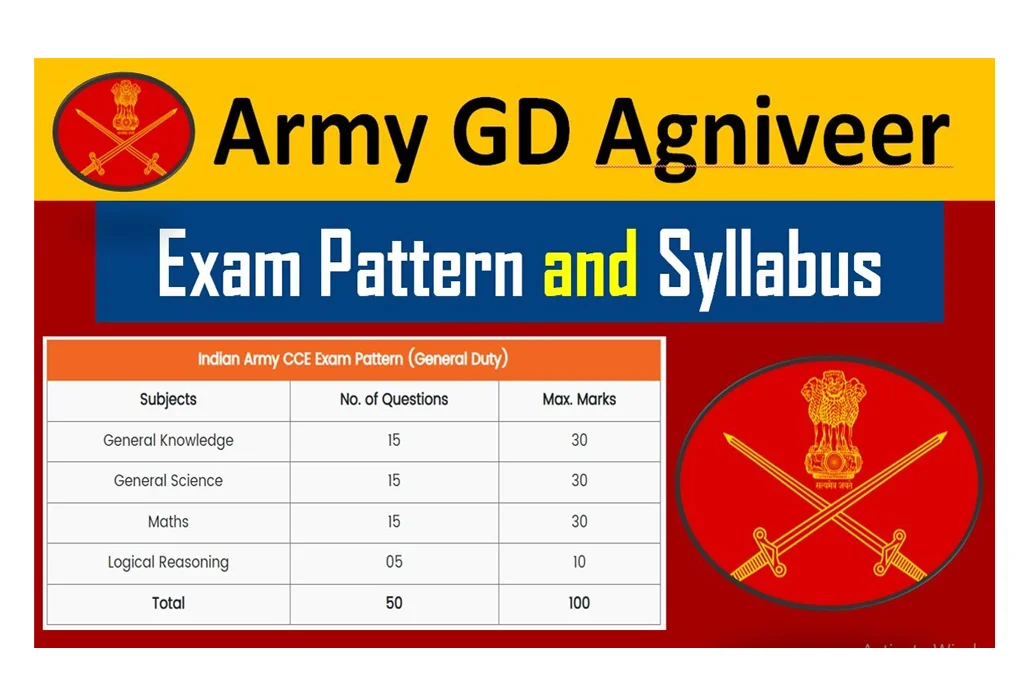
| Subject | Syllabus |
| General Knowledge | Abbreviations – National and International. |
| Sports – National and International. |
| History – Important dates & battles in Indian and World History and landmarks of Indian History, and the national movement. |
| History – Important dates & battles in Indian and World History and landmarks of Indian History, and national movement. |
| Geography – Solar System Space exploration, The earth’s principal peaks, Deserts, Rivers, Lakes and famous waterfalls, Geographical Tallest, Biggest and Longest, Indian States and Capitals, etc. |
| Terminology – Geographical terms, Economic terms, Astronomical terms, Legal terms and Misc terms. |
| Countries and Currencies |
| Current Important Events |
| Important Financial, Economic News and Banking News |
| Indian Constitution |
| Important Days |
| UNO |
| Indian Armed Forces. |
| International Space Stations and Festivals of India and the World. |
| Institutions and Research Stations, |
| Continents and Subcontinents. |
| Indian News Agencies and Dailies. |
| International Organisations. |
| Inventions and Discoveries. 2 Environment. |
| The Constitution of India. |
| Religious communities and Principal Languages. |
| National and International Days. |
| The question of General Science, which consists of topics related to Physics, Chemistry and Biology based on fundamentals and day-to-day activities |
| Books and Authors. |
| The world of Plants and animals. |
| Current Affairs and “Who’s Who”. |
| General Science | Human Body |
| Food and nutrition, |
| Diseases and prevention, vitamins and their uses. |
| IO/Numerical Ability |
| Medical Terms, |
| Scientific Terms, |
| Scientific and Research Institutes in India. |
| Ratio and proportion: meaning and standard form, |
| The questions will be based on the ability of the candidates in the age groups ranging between 16 & 20 years. |
| Mathematics | Algebra |
| Addition |
| Subtraction |
| Multiplication and division of algebraic expressions |
| HCF & LCM |
| Factorization |
| Simple Equations |
| Surds |
| Indices |
| Logarithms |
| Solution of linear equations of two and three variables. |
| Area of four walls of a room, area of a circle, sector and segment of a circle; surface area and volume of a cube, cuboid cone, cylinder, sphere. |
| Roots and discriminant of a quadratic equation ax^2+ bx + c = 0 |
| Arithmetic |
| Natural numbers |
| Integers and Fractions |
| Rational/irrational numbers |
| Decimal fractions |
| HCF & LCM |
| Square root |
| Ratio and Proportion |
| Percentages |
| Averages |
| Profit & Loss |
| Simple and compound interest |
| Mensuration |
| Area and Volume: |
| Article, Noun and Pronoun, Adjective, Preposition, Conjunction and Modals. |
| Trigonometry |
| Area of four walls of a room, area of a circle, sector and segment of a circle; surface area and volume of a cube, cuboid, cone, cylinder, sphere. |
| Heights and Distances |
| Solution of simple problems of height and distance using trigonometric tables and logarithmic tables. Geometry |
| Lines and Angles |
| Statistics |
| Histograms with given intervals |
| Classification of data |
| Frequency |
| Frequency polygons |
| Mean, median and mode of grouped and ungrouped data, problems related to statistical techniques. |
| General English | Parts of Speech |
| Use of Phrases, Direct and Indirect Speech |
| Verbs |
| Tenses: Present/past forms, Simple/continuous form, perfect forms, future time reference |
| Sentence Structures |
| Components of a computer system – Central Processing Unit (CPU), Visual Display Unit (VDU), Keyboard. |
| Types of Sentences: Affirmative/Interrogative Sentences |
| Other Areas |
| Idioms and Phrases |
| Synonyms and antonyms |
| One word substitution |
| Computer Science | Computer System |
| Characteristics of a computer |
| Basic applications of a computer |
| Using the Mouse and moving icons on the screen |
| Concept of memory |
| Primary and Secondary Memory |
| RAM and ROM, Units of Memory – Byte, Kilobyte, Megabyte, Gigabyte, Terabyte. |
| Input/Output Devices |
| Mouse |
| JoyStick |
| Scanner |
| Microphone |
| OCR |
| MICR |
| Light pen |
| Barcode Reader |
| Digital Camera |
| Printer, Speaker |
| Plotter. |
| MS-Windows |
| The basic concept of an Operating System and its functions. |
| Introduction to Windows |
| Area of four walls of a room, area of a circle, sector and segment of a circle; surface area and volume of a cube, cuboid, cone, cylinder, sphere. |
| My computer |
| Recycle Bin |
| Task Bar |
| Start Menu and menu selection |
| running an application, |
| Creating and renaming files and folders |
| Windows Explorer to view files, folders and directories |
| Setting the system date and time |
| Opening and Closing of Windows Minimise |
| Font Type, Size, changing colour, alignment of text |
| Basic components of a Window: Desktop, Frame, Title Bar, Menu Bar, Status Bar, Scroll Bars (Horizontal and Vertical) |
| Using the right button of the Mouse |
| Creating Shortcut |
| Basic Windows, Accessories: Notepad, Paint, Calculator, Wordpad. |
| MS-Word |
| Introduction to a Word Processor, |
| Creating and Saving a Document, |
| Editing and Formatting a Document ; Text Style (B.I.U), |
| Editing and Formatting a slide: Adding Titles, Subtitles, Text, Background, Watermark, Headers and Footers, Numbering Slides. |
| Formatting paragraphs with line or paragraph spacing |
| adding headers and footers, numbering pages, using |
| grammar and spell utilities, |
| using subscripts and superscripts, |
| inserting symbols, |
| Print Preview, Printing a document, |
| Inserting WordArt, Clipart and Pictures, |
| Page setting, |
| Bullets and Numbering, |
| Borders and Shading, |
| Format painter, |
| Find and Replace, |
| Inserting Tables: inserting, deleting rows and columns, merging cells, splitting cells, using the auto format. |
| MS-Powerpoint |
| Introduction to presentation Graphics, |
| Understanding the concept of slideshows, the Basic elements of a slide, |
| Different types of slide Layouts, |
| Creating and saving a presentation, |
| Different views of a slide: Normal view, Slide Sorter view and Slide Show, |
| Editing and formatting a worksheet, including changing color, size, font, alignment of text, and inserting or deleting cells, rows and columns. |
| MS-Excel |
| Introduction to Spreadsheets, |
| Concept of Worksheets and workbooks, |
| Creating and Saving a worksheet, |
| Working with a spreadsheet: entering numbers, text, date/time, |
| series using Autofill, |
| Editing and formatting a worksheet, including changing colour, size, font, alignment of text, and inserting or deleting cells, rows and columns. |